



When candidates face the modern hiring landscape, the baseline metrics can feel impenetrable: an average 44-day hiring cycle, hundreds of applicants per opening, and automated filters parsing resumes at enterprise scale. In Episode 12 of The Broken Handle, Will and JB dismantle the architecture behind enterprise recruiting engines using hard benchmark data from SHRM, Lightcast, ManpowerGroup, and LinkedIn.
Moving past conventional job-search myths, Will and JB explain why companies aren’t actively trying to filter out talent; rather, enterprise talent acquisition teams are managing massive data volumes while matching specialized operational needs. They break down why 51% of organizations struggle with talent shortages while recruiters balance an average of 14 simultaneous requisitions. The hosts unpack Lightcast’s discovery of skill velocity—the fact that 33% of core role skills evolve every 36 months—revealing why job requisitions frequently look like moving targets seeking “unicorns”.
In the second half, the hosts dissect how enterprise platforms like Workday, SAP SuccessFactors, and Greenhouse categorize work. They explain how 75,000 unique titles map into fewer than 2,000 standardized occupations connected to 34,000 discrete skills and 36,000 validated task statements. Learn why public job boards yield 49% of applications but only 24.6% of hires, how to structure resumes using Google’s XYZ formula to provide system-level proof, and how to leverage active listening to stand out when 78% of hiring misalignments come down to communication and soft skills.
Key Topics Covered
The 44-Day Hiring Reality: Unpacking SHRM benchmark data to understand why vetting cycles extend to 44 days as companies balance operational risk against strict qualifications.
The Recruiter Balancing Act: Why talent acquisition teams managing 14 open requisitions simultaneously rely on rapid, high-confidence signal detection.
Skill Velocity (The 33% Rule): Understanding why 33% of skills across jobs evolve every three years, causing job requisitions to blend immediate operational fixes with future technology shifts.
Enterprise Taxonomy Architecture: How modern ATS engines (Workday, SAP SuccessFactors, Greenhouse) map 75,000 unique job titles down to 2,000 standard occupations, 34,000 skills, and 36,000 tasks.
The Public Job Board Deficit: Why public job portals generate 49% of incoming candidate volume but account for only 24.6% of hires.
Task-Oriented Resume Structuring: Shifting from passive job descriptions to Google’s XYZ framework (Accomplished X, measured by Y, by doing Z) to pass parsing algorithms and engage human recruiters.
The Soft Skills Filter: Analyzing LinkedIn and Jobvite data showing that 78% of hiring misalignments stem from soft skills and communication gaps rather than technical capabilities.
Accelerating the Cycle with OSINT: How pre-interview research on company milestones, operational pain points, and market context converts standard interviews into strategic working sessions.
Actionable Frameworks From This Episode
1. The Enterprise Taxonomy Matching Engine
Enterprise talent platforms do not simply look for keyword matches or job titles. They parse candidate submissions across a three-layer taxonomy:
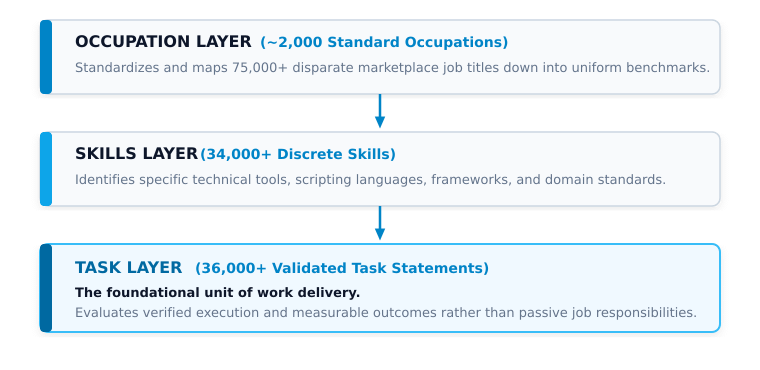
The Takeaway: Titles are inconsistent across companies. To score highly in taxonomy engines, anchor bullet points in validated task statements and concrete tool executions rather than high-level responsibilities.
2. Google’s XYZ Metric Formula
Every bullet point in your work history must connect task execution to validated business outcomes:

Weak (Generic Duty): “Responsible for network monitoring and responding to security alerts.”
Strong (Task-Aligned XYZ): “Engineered automated incident response workflows across 500 endpoints [Z], reducing average threat triage time by 45% [Y], improving operational containment velocity [X].”
3. The 3-Tier Interview Alignment Matrix
Interviews are structured across distinct organizational gates to evaluate three critical layers:
The Recruiter/HR Screen (Baseline Fit): Confirms basic operational requirements, salary expectations, benefits alignment, and professional communication hygiene.
The Hiring Manager/Technical Review (Task Depth): Tests deep task competence, tool-specific mastery, problem-solving methodologies, and ability to handle competing priorities.
The Executive/Department Review (Organizational Fit): Assesses cross-functional collaboration, long-term leadership potential, high-trust reliability, and cultural integration.
Resources & Data Cited
HR Benchmarks & Sourcing Statistics: Society for Human Resource Management (SHRM) Survey of 2,300 HR leaders.
Labor Market Intelligence: Lightcast Global Talent Taxonomy & Skill Velocity Datasets.
Talent Acquisition Studies: Jobvite Recruiting Nation Report & ManpowerGroup Talent Shortage Studies.
Workplace Misalignment Research: LinkedIn Talent Solutions & Glassdoor Workplace Research.
Work History Audit Checklist
Before submitting a resume through an enterprise application portal, verify:
[ ] Lead with Action Verbs: Did you eliminate all first-person pronouns (”I”, “we”, “my team”) and lead each bullet with an active verb?
[ ] Specific Tool Stacking: Did you explicitly name the tools, standards, and environments used (e.g., Splunk, Terraform, AWS, Wireshark, NIST 800-53) rather than generic terms like “monitoring software”?
[ ] Quantified Scale: Did you quantify your operational footprint (number of tickets, endpoints, budget size, database records, users supported)?
[ ] Skill Velocity Proof: Did you include recent certifications, tooling adoptions, or updated frameworks to prove you adapt to the 33% skill shift every 36 months?
Connect with the Show
Website & Resource Archive: thebrokenhandle.com
Social Updates: @brokenhandlepod (All major platforms)
Subscribe & Review: Available on Apple Podcasts, Spotify, YouTube, and Substack. If this breakdown helped clarify your job search strategy, subscribe and drop an honest review to support the show.


