



Moving away from the formal labor statistics and market reports of previous weeks, Episode 13 of The Broken Handle is an unvarnished, “off-the-cuff” session. Will and JB pull back the curtain on the daily frictions, absurdities, and ethical dilemmas that both candidates and talent acquisition professionals navigate in today’s unpredictable hiring landscape.
Drawing from real-time interactions—from recruiters blasting irrelevant out-of-state roles with mandatory five-day on-site mandates to agencies pushing candidates to embellish qualifications—Will and JB analyze where the hiring pipeline breaks down. They dig into the mechanics of third-party recruiting economics, unpacking why multiple headhunters often pitch the exact same requisition at varying pay rates and how candidates can recognize when a role has been sitting vacant due to toxic internal client realities.
The hosts examine the rising pressures facing honest recruiters, including the influx of AI resume flooding and technical interview fraud (such as real-time deepfake filters and voice modulators). Finally, Will and JB outline practical strategies for both sides of the hiring table. They establish non-negotiable boundaries for candidates—vetting recruiters, demanding formal job descriptions, and refusing to disclose past compensation—while urging talent teams to act as trusted advisors who push back against unrealistic hiring managers rather than spamming passive candidate inboxes.
Key Topics Covered
The “Punt the Laptop” Factor: Managing the emotional fatigue and cynicism that builds during prolonged searches and repetitive recruiter interactions.
Automated Blind Blasting vs. Precision Sourcing: Why casting an untargeted net for non-matching, out-of-state roles degrades candidate trust and agency reputation.
The Return-to-Office Friction: Companies struggling with sparse local talent pools while refusing remote or hybrid flexibility.
The Multi-Recruiter Requisition Dynamics: What it means when four or five agencies pitch the exact same position, and how candidates can use that leverage to compare bill rates.
The Stale Requisition Warning: Why roles open for months across dozens of agencies often signal unrealistic expectations or toxic management rather than opportunity.
Ethical Guardrails & Deception: Why asking candidates to falsify resumes backfires in technical screens, and how AI interview deception (deepfake filters, voice modulation) is driving strict technical vetting.
The “Contract-to-Hire” Illusion: Navigating the real risk of headcount freezes and temporary bridge roles that derail long-term resume trajectory.
Boundary Setting & Salary Defense: Vetting third-party recruiters before sharing data, and deflecting past compensation inquiries to anchor your true market value.
Actionable Frameworks From This Episode
1. The Recruiter Vetting & Triage Protocol
Before investing time updating your resume or scheduling an intake screen with an agency recruiter, run this four-point check:
Exclusive Requisition Verification: Inquire if the agency holds an exclusive recruiting agreement with the client or if the role has been released to the open market.
Formal Job Description Mandate: Never agree to an introductory phone interview without reviewing a written, formal job description with verified technical requirements.
Requisition Longevity Check: Ask how long the position has been open and why the previous occupant departed. If the role has cycled through multiple agencies for months, treat the internal team culture with caution.
Explicit Compensation Banding: Require the exact salary range or hourly contractor rate upfront. Never accept vague ranges or defer compensation discussions until after technical vetting.
2. Defending Compensation & Past Salary Traps
Deflecting Past Compensation: When asked “What did you make on your last contract/role?”, avoid answering. Anchoring to past compensation limits your current market value and biases agency commission structures.
The Market-Anchored Script: Respond with boundary-focused clarity:
“My previous compensation was structured around an entirely different set of operational deliverables and business constraints. Based on current market rates and the scope outlined for this role, my target range for this position is [$X to$Y].”
Connect with the Show
Official Website & Resources: thebrokenhandle.com
Social Communications: @brokenhandlepod (All platforms)
Streaming Channels: Available on Apple Podcasts, Spotify, YouTube, and Substack. If this candid conversation helped validate your hiring frustrations, drop a review and share it with someone currently navigating the market
Artifact 1: The Candidate Recruiter-Screening & Red Flag Matrix
A Field Guide for Evaluating Third-Party Headhunters and Protecting Candidate Runway
The Broken Handle Podcast | Episode 13 Framework Deliverable
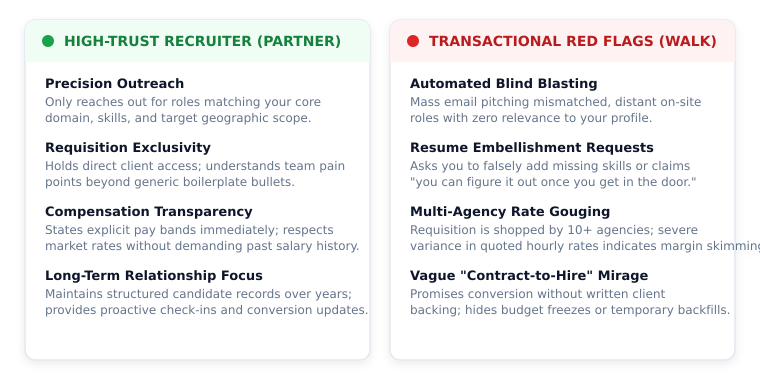
Candidate Verification Checklist
When contacted by a new third-party agency, enforce these four checks:
[ ] Require Written Scope: Demand the formal job requisition detailing deliverables, team hierarchy, and travel requirements prior to an intake call.
[ ] Inquire on Exclusivity: Ask: “Are you working directly with the hiring manager on an exclusive retainer, or is this role circulating across multiple agency vendor lists?”
[ ] Audit Role Longevity: Inquire how many weeks the role has remained unfilled. Persistent listings that cycle through multiple staffing agencies often indicate unrealistic client expectations or internal dysfunction.
[ ] Withhold Historical Compensation: Decline to disclose past salary data. Defend your current rate based on market value, scope, and technical deliverables.
Artifact 2: The Two-Way Hiring Contract: Setting Candidate & Recruiter Boundaries
A Strategic Blueprint for Aligning Candidate Expectations, Defending Market Rates, and Eliminating Hiring Slop
The Broken Handle Podcast | Episode 13 Framework Deliverable
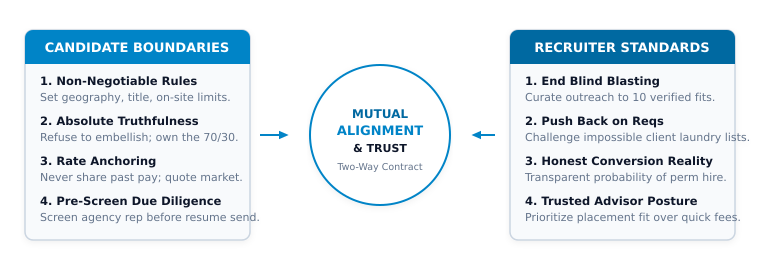
1. Candidate Boundary Operating Rules
Define Inflexible Parameters Early: Document your geographic boundaries, maximum commute radius, acceptable work modes (remote, hybrid, on-site), and minimum required base compensation before entertaining agency outreach.
Maintain Strict Integrity: If an agency recruiter suggests embellishing code repositories, inflating titles, or exaggerating tooling depth, decline and walk away. Discrepancies get exposed during technical interviews and harm your professional reputation.
Protect Past Salary Data: What you earned in previous roles reflects past organizational budgets, not your current value. Anchor every compensation discussion to the target role’s market requirements.
2. The Recruiter Professional Standard
Curate Targeted Candidate Pools: Stop automated blind blasting. Sourcing 10 well-qualified, thoroughly reviewed candidates yields higher conversion rates and preserves your professional brand.
Challenge Unrealistic Hiring Managers: Act as a strategic advisor to your corporate clients. When a hiring manager drafts an impossible requisition seeking entry-level candidates with senior architecture capabilities, use market feedback to calibrate their expectations.
Provide Complete Role Transparency: Clarify whether a position is a temporary project backfill or a genuine contract-to-hire opportunity. Candidate trust is built on upfront clarity, ensuring sustainable long-term placements.


