



When regular direct deposits arrive every Friday, your financial life feels completely stable—even when your reserve funds are quietly burning away. In Episode 14 of The Broken Handle, Will and JB confront the “Cash Flow Illusion,” dissecting the dangerous psychological trap that blinds job seekers, contractors, and career pivoters right before their financial runway runs out.
Anchoring the discussion in empirical research from Peter Ganong and Pascal Noel published by the National Bureau of Economic Research (NBER), Will and JB explain the reality of household spending drops. They break down why spending dips roughly 6% at the onset of unemployment, but plummets by an additional 12% the exact week benefits expire—a secondary cliff larger than all earlier spending drops combined. Drawing from real-time transitions, they examine why predictable end dates still catch families off guard and how to prepare for prolonged searches when Bureau of Labor Statistics (BLS) data indicates that more than 25% of unemployed workers remain out of work for 27 weeks or longer.
In the second half, the hosts address the post-employment shock. They reveal why landing a new role triggers a “Second Cliff,” where lingering “lifestyle debt” collides with delayed payrolls, partial pay periods, and lower starting salaries. Through a six-lesson operational blueprint, Will and JB teach listeners how to separate earned income from dollars borrowed from the future, build defensible rebuild plans for retirement withdrawals, construct a ranked protected spending list, and deliberately “downshift on purpose”.
Key Topics Covered
The Cash Flow Illusion: Why consistent weekly deposits (unemployment, savings drawdowns, severance) mask burning runway and create dangerous false complacency.
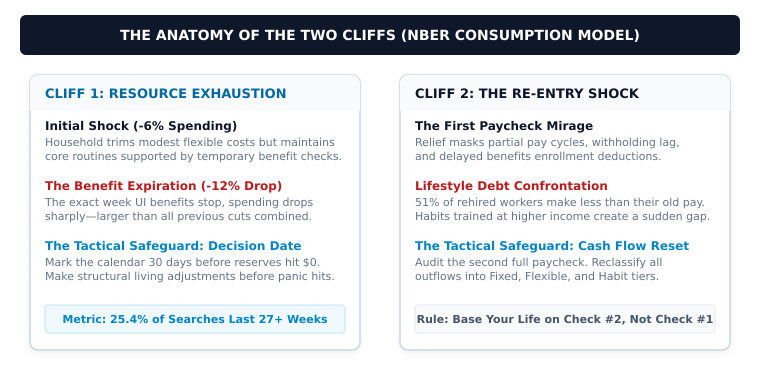
The NBER Spending Cliff Study: Examining the Ganong & Noel data showing an initial 6% spending drop at layoff followed by a sharp 12% plunge when benefit checks exhaust.
The Two Cliffs of Career Disruption: Defining Cliff 1 (when temporary support runs out) and Cliff 2 (when legacy spending habits meet a smaller or delayed new paycheck).
Planning for the Long Tail: Why financial plans must account for BLS benchmarks showing 25.4% of job seekers remain unemployed for 27+ weeks.
The Source Page Audit: Classifying every deposit into “Earned” versus “Borrowed from the Future” to calculate your true underlying monthly deficit.
The Cost of Irreversible Moves: Deconstructing IRS early withdrawal penalties (10% additional tax plus 20% mandatory withholding) and writing binding 3-line rebuild plans.
Lifestyle Debt & Self-Continuity: Leveraging consumer psychology research (Schambacher, Bhatti, & Faro) to align current routines with your future financial reality.
Downshifting on Purpose: Evaluating career moves across four balanced dimensions—Money, Time, Stress, and Growth—rather than money alone.
Actionable Frameworks From This Episode
1. The Two-Cliff Career Transition Model

Cliff 1 (The Resource Exhaustion Date): Occurs the exact week unemployment insurance or cash reserves deplete. The spending drop here is steep (-12%) because households adjust to the rhythm of deposits rather than the approaching deadline
Cliff 2 (The Reset Shock): Occurs upon reemployment. The first paycheck rarely covers a full normal cycle, and legacy spending habits formed at a higher income level create immediate cash deficits.
2. The 6 Lessons of Cash Flow Management
Lesson 1: Name the Source of Every Dollar: Label every incoming dollar as Earned or Borrowed from the Future. If your borrowed total is high, you have identified your true monthly gap regardless of your bank balance.
Lesson 2: Know Your Cliff Date & Decision Date: Calculate the exact day your earliest cash reserve runs dry. Establish a Decision Date precisely 30 days prior to execute structural budget cuts or expand search parameters before panic sets in.
Lesson 3: Attach a Rebuild Plan to Every Irreversible Move: Never touch retirement or long-term assets without a 3-line written agreement stating what was taken, the monthly repayment amount, and the exact date repayment begins.
Lesson 4: The First Paycheck Is Not the Finish Line: Treat the second and third paychecks as your real operational baseline. Triage recurring expenses across Fixed, Flexible, and Habit tiers.
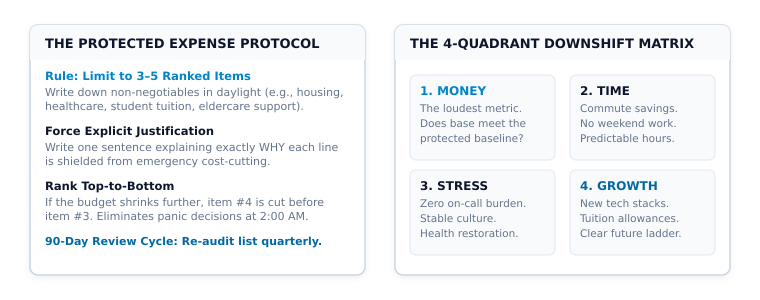
Lesson 5: Decide What Is Protected Before You Cut: Write down 3 to 5 non-negotiable items (e.g., mortgage, healthcare, child tuition) in daylight. When budget shortfalls occur, cut unprotected lines first rather than making emotional decisions under stress.
Lesson 6: Downshift on Purpose: When reentering the workforce at lower pay, evaluate total compensation across four quadrants: Money, Time, Stress, and Growth. Choose your reset deliberately.
Resources & Research Cited
Household Consumption Dynamics: Ganong, Peter & Noel, Pascal (2019), Consumer Spending During Unemployment, National Bureau of Economic Research (NBER Working Paper).
Unemployment Duration Data: U.S. Bureau of Labor Statistics (BLS) Employment Situation Report (March 2026 / Displaced Worker Survey August 2025).
Emergency Cushion Benchmarks: Federal Reserve Board, Economic Well-Being of U.S. Households (Covering liquid emergency savings).
Consumer Psychology & Reset Behavior: Schambacher, Bhatti, & Faro (2024), Self-Continuity and Spending Adjustments, Journal of Consumer Psychology.
Retirement Hardship Withdrawal Statistics: Vanguard, How America Saves 2026 Report.
Tax Code Compliance: Internal Revenue Service (IRS) Guidelines on Early Distributions and Mandatory Withholding (Updated Fall 2026).
Connect with the Show
Official Website & Full Show Notes: thebrokenhandle.com
Social Updates: @brokenhandlepod (All major streaming & social channels)
Subscribe & Stream: Listen on Apple Podcasts, Spotify, YouTube, and Substack. If these frameworks helped bring clarity to your financial runway, leave an honest review to help others find the show.
Episode 14 Listener Deliverables & Guides
Artifact 1: The Transition Runway & Cliff-Date Calculator
A Field Guide for Mapping Real Cash Flow, Auditing Inflows, and Preparing for Benefit Expirations
The Broken Handle Podcast | Episode 14 Framework Deliverable
The Source Page Execution Checklist
Execute this monthly audit to eliminate the cash flow illusion:
[ ] Audit Every Deposit: Print bank statements for the last 30 days. Identify every credit line.
[ ] Tag Deposits Bluntly: Label each line item as either Earned (recurring compensation that replaces itself) or Borrowed from the Future (savings withdrawals, retirement distributions, credit debt, temporary UI benefits).
[ ] Calculate the Monthly Deficit: Sum all borrowed dollars. This total is your Real Monthly Gap.
[ ] Pinpoint Cliff Date: Divide liquid cash reserves by your Monthly Gap to establish your runway.
[ ] Set Decision Date: Place a hard calendar hold exactly 30 days prior to your Cliff Date. If reemployment is not finalized by this date, execute pre-planned lifestyle contractions immediately.
Artifact 2: The Downshift Decision & Protected Spending Blueprint
A Framework for Protecting Non-Negotiables and Evaluating New Roles Beyond Base Pay
The Broken Handle Podcast | Episode 14 Framework Deliverable
The 3-Line Irreversible Move Binding Contract
If you must tap a 401(k), IRA, or long-term reserve to cover living expenses, you must document this binding repayment contract before moving capital:
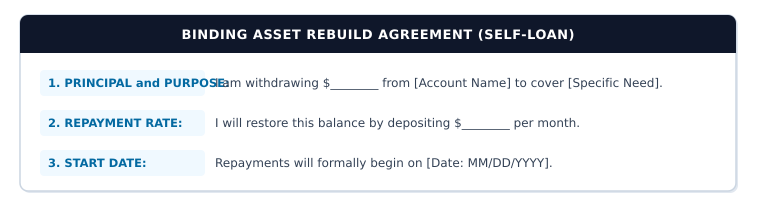
Note: A modest repayment schedule ($50/month) with a fixed start date is defensible; an ambitious plan without a start date is simply a wish.


